


Ensuring that every child develops confident reading skills is a priority for primary schools, yet pupils with special educational needs and disabilities (SEND) often face additional barriers to literacy.
For SENDCOs and school leaders, providing effective reading intervention requires a strategic, evidence-based approach that addresses diverse learning needs while working within the realities of curriculum demands and resource constraints.
Literacy for All: Strategies for Primary Pupils with SEND is a practical guide designed to support educators in implementing inclusive, research-informed literacy strategies. It explores key approaches to improving reading outcomes for SEND learners, with a focus on adaptive instruction, targeted support, and data-driven decision-making.
This guide will help you:
- Deliver more effective literacy support: Tailor literacy instruction to meet the needs of learners with dyslexia, ADHD, and speech and language difficulties.
- Save time and enhance impact: Explore the role of adaptive learning and technology in delivering personalised reading intervention.
- Make data work for you: Use assessment and real-time data to inform targeted interventions and demonstrate impact.
By embedding these approaches into literacy provision, schools can take meaningful steps towards closing the attainment gap and ensuring equitable access to reading development.
Download the guide to explore strategies that support all learners in building essential reading skills.

See the Results for Yourself – Request a Free 30-Day Evaluation
Want to experience the impact of Lexia Core5 in your school? We’re offering a free 30-day evaluation for schools interested in seeing how Lexia Core5 can support their students’ literacy skills development.
Fill out the form below to enquire about a 30-day evaluation of Lexia Core5 Reading

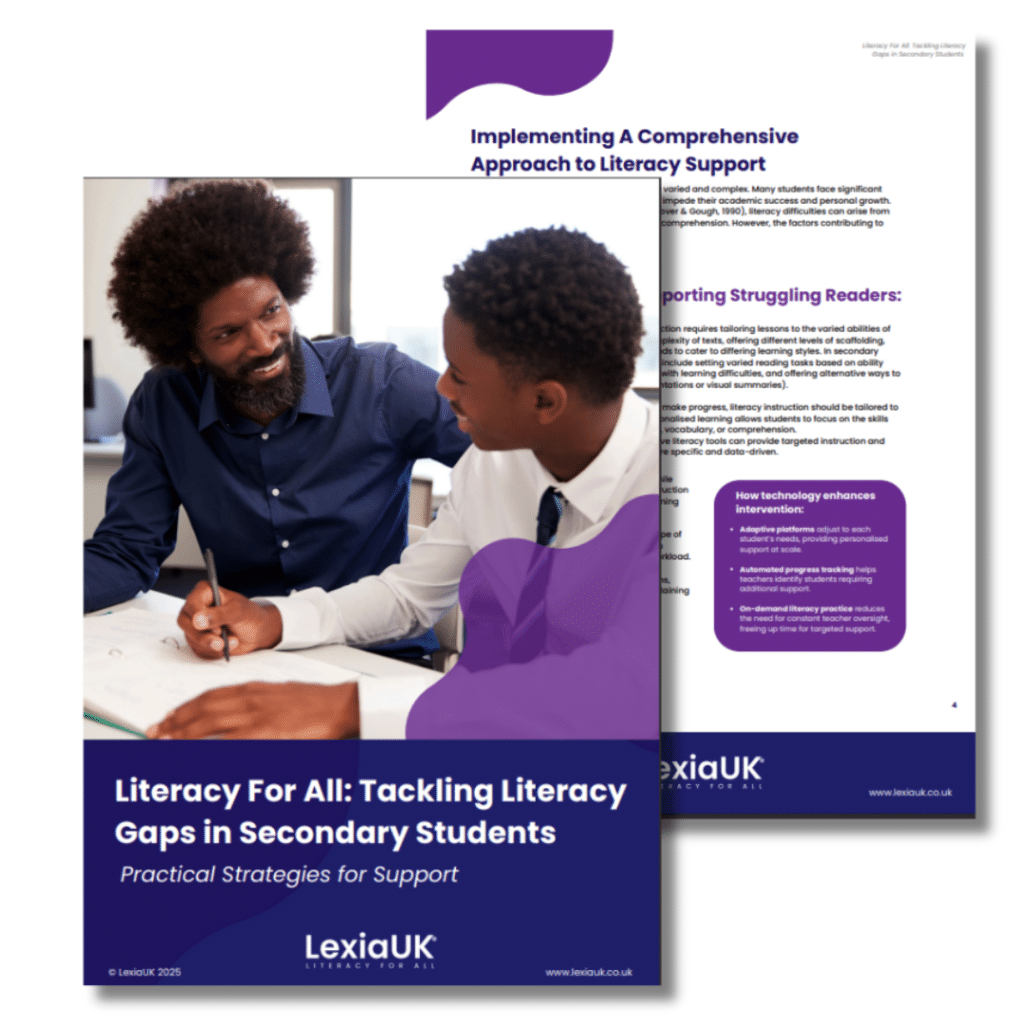
Free Downloadable Guide: Literacy For All: Tackling Literacy Gaps in Secondary Students & Practical Strategies for Support.
Last year, over 120,000 students from disadvantaged backgrounds entered secondary school below the expected standard for reading. Students arrive with different skill levels, and factors such as SEND, socio-economic barriers, and EAL can further widen gaps in spelling, grammar, and comprehension. Without the right support, these challenges can affect access to the curriculum, engagement in learning, and success in GCSEs.
This free guide explores:
- The key literacy challenges facing secondary students, including low reading age and difficulties with comprehension
- Practical strategies for literacy support, including approaches for SEND, disadvantaged students, and those eligible for Pupil Premium
- The role of reading intervention and adaptive teaching in improving literacy outcomes at scale
- How technology and data-driven instruction can help close literacy gaps and build core literacy skills
Building Stronger Literacy Foundations
By understanding the diverse needs of secondary students and applying evidence-based strategies, schools can create a more inclusive, effective approach to literacy support.
See the Results for Yourself – Request a Free 30-Day Evaluation
Want to experience the impact of Lexia PowerUp in your school? We’re offering a free 30-day evaluation for schools interested in seeing how Lexia PowerUp Literacy can support their students’ literacy skills development.
Fill out the form below to enquire about a 30-day evaluation of Lexia PowerUp Literacy

Choosing the right literacy intervention programme is a crucial decision for school leaders looking to improve student outcomes. With so many options available, it can be overwhelming to know where to start. This post will offer practical advice on selecting an effective programme, including how to evaluate claims, consider evidence, and ensure the programme meets the diverse needs of your students. We will also discuss the value of trying out a programme in your own school environment and connecting with peers in similar settings.
1. Start with the Evidence
When evaluating a literacy intervention programme, it’s essential to look beyond the provider’s marketing claims and focus on the robustness of their collected evidence. While some providers may boast impressive results, school leaders should critically assess the quality and reliability of the research underpinning these claims. For instance, the findings from a small-scale pilot involving only a handful of children are inherently less reliable than those from a large-scale, multi-school study where hundreds of children are divided into carefully matched control and treatment groups. To assist schools with navigating these complexities, the Education Endowment Foundation (EEF) provides independent and maintains a “Promising Programmes” list, highlighting thoroughly researched, evidence-based interventions. This list can offer schools a practical starting point from where to begin their selection process.
Key factors to consider include:
- Has the programme been independently evaluated for its effectiveness?
- Does it show measurable improvements in literacy outcomes?
- How well does it align with your school’s priorities and challenges?
Be cautious of programmes that make broad claims without clear, evidence-backed results, and ensure that the programme fits the unique needs of your students.
2. Ensure the Programme Meets Multiple Needs
Each pupils’ literacy needs are unique and the programme you choose should be able to address a broad range of student needs. Consider a programme that can support not only struggling readers but also those who are ready for additional challenges. Over time the needs of your students will change and the program you choose should be broad enough to support them beyond the ‘catch-up’ stage.
Look for features that allow the programme to be flexible in addressing various aspects of literacy, including phonics, comprehension, vocabulary, and fluency. It should also be adaptable for different learning styles and levels, ensuring that all students receive the essential support they need.
A good literacy programme should also consider the diverse needs of students, including those with learning difficulties or English as an additional language. Ensuring that the programme is comprehensive and differentiated will lead to better outcomes for a wider range of learners.
3. Test the Programme in Your Own School Environment
Before committing to a literacy programme, it’s crucial to evaluate how well it works in the context of your own school. This includes assessing how easily the programme can be integrated into your existing curriculum and teaching methods.
A hands-on trial period can provide invaluable insights into how the software works in practice. Used alongside published evidence, this trial period allows you to see first-hand how the programme functions in a real classroom setting, how students engage with it, and how teachers find its ease of use and effectiveness.
During the trial, it’s also important to assess the support and resources available to your teaching staff, as training and professional development will be vital to successful implementation. This will also give you a clearer idea of the programme’s long-term viability in your school.
4. Speak to Similar Schools and Users
One of the best ways to assess the effectiveness of a literacy programme is by talking to other schools that have used it. Reach out to schools with similar challenges or demographics and ask about their experiences with the programme. A potential provider should be able to put you in touch with a school who can give you a personal and independent view.
Peer feedback is invaluable in understanding the practical implications of using a specific programme. Schools that have seen positive results can offer insights into how the programme has helped their learners and the support they received during implementation.
Many programme providers will also offer case studies or testimonials from schools that have used the product successfully. Engaging with these resources can provide a clearer picture of how well the programme could work in your own setting.
Other sources of school feedback can be obtained from educational review sites such as EdTech Impact. Here you can search possible solutions and read independent educator reviews.
5. Ensure Ongoing Support and Training
A successful literacy programme doesn’t end after the initial implementation – it requires ongoing support and professional development to ensure long-term impact. When evaluating programmes, remember to thoroughly research this often-overlooked aspect of the selection process.
Ask providers specific questions about how they handle ongoing support. For instance, do they have a dedicated team of trainers? If not, how will support be delivered, and are there additional costs involved? Look for programmes that offer regular training, continuously updated resources, and accessible support channels to help teachers implement and refine their approach. This commitment to ongoing implementation ensures your staff feel confident using the programme, so that pupils continue to benefit from it.
Conclusion
Selecting the right literacy intervention programme is a critical decision for your school, and it’s essential to choose one backed by solid evidence, flexibility, and ongoing support. At LexiaUK, we are committed to helping schools transform literacy outcomes through our adaptive, evidence-based programmes. With a focus on empowering both students and educators, our solutions are designed to meet the diverse needs of all learners. Like thousands of schools from across the UK, start your Lexia journey with a 30-day free evaluation of our programme today and see how we can help unlock every student’s reading potential.
Enquire to begin your 30-Day Evaluation of Lexia

Effective literacy intervention can transform the learning experience for students, but achieving success requires thoughtful planning and consistent support. In this post, we’ve gathered advice from schools that have seen remarkable results with Lexia. These star schools share tips and strategies that helped them maximise the impact of the programme and ensure that students not only engage but thrive.
1. Ensure timetabling is closely considered
“We have found that timetabling has had the biggest impact to our Lexia implementation. We made sure to consider which lessons were appropriate to take pupils out of to complete Lexia avoiding their core subjects, PE, and PSHE. This has really helped to ensure that everyone gets a minimum of 2 sessions. We have also considered which pupils will benefit from one-to-one sessions, so we have been able to ensure that additional needs are met.”
– Rebecca Wilson, Theale Green School, Reading.
2. Give teachers and learners time to adjust to new routines
“Keep on with it! Give it time. If it is a new intervention strategy to you, there is so much to delve into and so many tools that you may not be aware of yet, so I would say to take the time to get your head around it. Likewise with the learners, giving them the time to interact with the software and progress is important. With time, learners can begin to identify the situations and topics that they struggle with and allow them to address them with consistent practice and build those skills up.”
– Alex Parry, Upton-by-Chester High School, Cheshire.
3. Ensure all staff are trained on the programme
“I think training all staff, teachers and TAs alike, is crucial to a successful implementation. It was really important that we all had a shared understanding of why we were using Lexia and that everyone was on board with how responsive it was and the fact that it generates intervention planning for you. It was essential to get those benefits across so that it would be used consistently in class.”
– Kiran Satti, Oasis Academy Woodview, Birmingham.
4. Celebrate every success, no matter how small
“Share and celebrate every little bit of progress you are seeing. Getting that recognition in front of their class and the whole school has really given them a boost. There is a positive atmosphere in our Lexia sessions to the point where we have other pupils in school have been asking if they can join! For me, this just shows that they are really enjoying it and it is not just seen as an additional lesson. They’re seeing it as a fun session.”
– Mhairi Paton, Pembridge Hall School, London.
5. Ensure consistency with dedicated Lexia staff
“I think the main thing we would say is consistency is key. It works really well in our school because our roles are dedicated to delivering Lexia and we can ensure that pupils are getting access every single week.
Having trained members of staff responsible for Lexia has meant that it can be consistent, the kids know who to come to and can get into the routines needed to make progress. The fact that they can develop a positive relationship with their Lexia tutor has meant that engagement in the sessions has been high. Building those relationships is so important! Often, pupils at secondary that struggle with reading can be quite disengaged with lessons, so it is important to make the sessions and those connections as positive as possible.”
– Abbie Maguire and Beth Meacock, Oasis Academy Leesbrook, Oldham.
6. Take time to explore and make the most of LexiaUK’s annual training opportunities.
“Give yourself the time to really look at the program and how it works. Before you start, it’s good to start off with a small group of children or even create a test account for yourself so you can really discover what is available on Lexia because it is so vast and varied. Giving yourself that time is important. You need that personal input time to understand the content and be able to deliver it properly to promote confidence and that positive learning experience.
I felt that my Annual Review with LexiaUK was really helpful as well. It’s something that I hadn’t engaged in before, but I found the chat about our Implementation plan really helpful to enable me to target. My adviser emailed me a copy that I was able to take to my review with SLT and use to create goals for my personal achievement.”
– Lynne Tandy, Herne Junior School, Hampshire.

Lexia programs offer an evidence-based, personalised approach to literacy and reading support. However, implementing it effectively in your classroom can make a world of difference in how pupils engage and achieve. To help you get the most out of Lexia, we’ve gathered ten creative and practical strategies you can try.
Whether you’ve used Lexia in school for years or you’re just getting started, these ideas will help you integrate the programme seamlessly into your teaching while making it fun and inspiring for your students.
1. Set a Timetable for Success
Consistency is key when using Lexia. Establish a regular schedule for students to log in and progress through their personalised learning paths. Whether it’s 20 minutes during registration, a dedicated literacy carousel, or part of your intervention programme, a predictable routine ensures every pupil gets the time they need to succeed.
Pro Tip:
Incorporate Lexia into a learning carousel— pupils can independently work on Lexia while you lead small-group interventions.
2. Reward Progress, Not Just Completion
Celebrate small wins! Lexia’s goal-setting features make it easy to track progress, so why not reward students when they meet their weekly targets or advance in a level? Prizes don’t have to be extravagant—stickers, lunch passes, extra breaktime, or an acknowledgement during assembly can go a long way.
Classroom Idea:
Create a “Star Readers Wall” where students can proudly display their accomplishments and their Lexia Certificates.
3. Create a Lexia Leader Board
Foster friendly competition by introducing a Lexia Leader Board in your classroom. Use it to showcase pupils who have spent the most time on Lexia, completed the most units, or met their weekly targets. This visual cue not only boosts motivation but also builds a sense of community as students cheer on their peers.
4. Use Lexia as a Homework Tool
Encourage students to continue their literacy journey at home by assigning Lexia as part of their homework. The myLexia platform allows you to track at-home usage, making it easy to monitor progress beyond the classroom.
Tip:
Share our Advice for Parents video to support parents and guardians in making the most of Lexia time at home,
5. Launch a Lexia Progress Wall
Create a “Lexia Progress Wall” where students can visually track their own progress as they advance through different levels of the programme. Use colourful charts, graphs, or progress bars to show how far each student has come and celebrate their achievements as they reach milestones. This can be an interactive space where students update their progress themselves, making it an engaging and empowering experience.
Tip:
Add motivational quotes or celebrate class-wide milestones, such as “We’ve completed 100 levels together!” to foster a sense of community and achievement.
6. Integrate Lexia with Classroom Displays
Transform your learning environment with Lexia-themed displays. Use posters to highlight literacy skills like decoding or comprehension strategies, and pair these with examples of students’ work. Displaying progress visually reinforces the importance of literacy and keeps students engaged.
Idea:
Hang up a “Lexia Ladder” where students can move their name up as they progress through levels. For a more collaborative approach, you could create a “Lexia Tree” where students can add a personalised leaf each time they complete a level.
7. Introduce a Lexia “Challenge of the Week”
Each week, set a new challenge for your students, such as completing a certain number of units, reaching a specific level, or improving their session time. Encourage them to track their progress and compete in a fun, low-pressure way. Reward the winners with small prizes, such as extra reading time, classroom privileges, or a General Achievement certificate. This creates excitement and helps keep students motivated to consistently engage with their Lexia journey.
8. Connect Lexia to Cross-Curricular Goals
Make Lexia relevant to other areas of learning by linking it to your curriculum. For example, focus on comprehension skills from Lexia activities that align with upcoming topics in science or history. This not only reinforces key literacy skills but also helps students see the practical application of their learning.
9. Host a Lexia Literacy Day
Why not dedicate a day to celebrating literacy and Lexia? Organise a variety of fun and engaging activities such as a spelling competition, word games, an awards ceremony for top performers, or workshops for parents to explore the Lexia program. These events boost excitement, engagement and highlight your school’s commitment to literacy success.
10. Encourage Peer-to-Peer Learning
Foster a supportive classroom culture by encouraging students to work together and help each other with Lexia. Pair up students with similar levels to share tips, discuss strategies, and celebrate each other’s progress. You can also assign “Lexia Mentors,” and encourage pupils to help their peers with tricky activities or to motivate learning. This collaborative approach not only builds a sense of community but also reinforces learning as pupils explain concepts to one another in their own words
Free Download: Lexia Leader Board Template
To help you get started, we’re offering a digital, downloadable Lexia Leader Board template that you can customise for your classroom. Use it to track progress, celebrate milestones, and keep students motivated all term long!
Click here to download your Lexia Leader Board template.
We hope these tips inspire you to make Lexia an integral and exciting part of your classroom. Remember, literacy is a journey—and with Lexia, you have a powerful tool to guide every student toward success.
What are your favourite ways to use Lexia?
Share your ideas with us on X/Twitter @LexiaUK!

Reading is a cornerstone of learning, yet many primary pupils encounter challenges that can prevent them from achieving proficiency. Addressing these obstacles requires both targeted interventions and fresh approaches that go beyond ‘more of the same’. In this post, we’ll explore four common barriers to reading growth in Key Stage 2 pupils and share strategies to improve literacy in the classroom.
1. Stalling Progress with ‘More of the Same’ Approaches
For some pupils, traditional classroom strategies simply aren’t enough. This is especially true in Key Stage 2, where struggling readers may have fallen behind despite prior intervention. Without fresh approaches, these pupils risk continuing to lag further behind their peers.
How to Overcome This:
Teachers can support pupils by shifting to strategies that revisit and rebuild foundational skills while introducing engaging, differentiated instruction. Look for programs that identify gaps in learning and offer personalised, adaptive pathways to mastery. These approaches ensure that pupils aren’t stuck repeating methods that haven’t worked for them.
An effective solution should provide both students and teachers with a renewed approach—offering a way to re-engage pupils with targeted, manageable steps toward progress. Consider using technology to track mastery and provide immediate feedback, making the learning process more transparent and motivating for pupils.
2. The Challenge of Catching Up and then Keeping up
Many struggling readers in Key Stage 2 are expected to both “catch up” on missed Key Stage 1 skills and then “keep up” with increasingly complex content in upper school. Balancing these demands is challenging for both pupils and teachers.
How to Overcome This:
Effective catch-up strategies focus on identifying and targeting the specific gaps from Key Stage 1 that continue to hold pupils back. Diagnostic assessments can pinpoint which phonics, fluency, or comprehension skills need reinforcement. In addition, it’s crucial to then scaffold Key Stage 2 learning to ensure pupils can access age-appropriate texts and deepen their understanding of content.
Building comprehension and vocabulary skills in tandem with decoding skills provides a holistic approach to literacy development. A structured approach that integrates both catch-up and keep-up strategies ensures no time is wasted and that pupils remain on track to transition to secondary school as confident readers.
3. Ensuring Equity in Literacy Growth
Disadvantaged pupils are often disproportionately affected by literacy gaps, and traditional approaches may not address these needs effectively at the scale required. Teachers need solutions that ensure all pupils, regardless of their starting point, have access to equitable literacy instruction.
How to Overcome This:
Innovative use of technology can level the playing field, offering consistent, personalised instruction to every pupil. Research-backed adaptive programs adjust to each pupil’s needs, helping disadvantaged learners catch up and make real progress, even when resources are limited.
Additionally, focusing on growth milestones rather than simply meeting age-related standards can help build confidence and momentum for struggling readers. Providing regular opportunities to celebrate small victories encourages persistence and motivates pupils to continue improving.
4. Navigating the Overload of Literacy Strategies
With countless literacy programs and interventions available, it can be overwhelming to decide which approaches will truly benefit pupils. Many programs claim to be “research-based,” but there is an important distinction between being “research-based” and “research-proven.” Without clarity on the difference, teachers may invest valuable time and resources in strategies that lack evidence of effectiveness in real classrooms.
How to Overcome This:
To ensure pupils benefit from approaches that genuinely work, focus on strategies that are research-proven. These are programs that have undergone rigorous testing and evaluation, demonstrating measurable and consistent improvements in learning outcomes. A great place to start is the EEF Promising Programmes list, which highlights interventions backed by solid evidence.
When evaluating literacy programs, ask critical questions:
- Has the program been tested in settings like yours (e.g. primary schools)?
- Are the results of the research transparent and peer-reviewed?
- How significant were the outcomes, and were they sustained over time?
It’s also important to remember that even the best programs require effective implementation to succeed. Pairing research-proven interventions with professional development and ongoing teacher support will maximise their impact.
The Lexia Advantage
Lexia Core5 Reading is designed to help Key Stage 2 pupils overcome these common barriers, offering a truly fresh start for both learners and their teachers:
- A Renewed Approach Where “More of the Same” Isn’t Working: Core5 identifies and revisits Key Stage 1 skills not yet mastered, helping pupils catch up quickly while re-engaging them with reading in an enjoyable, age-appropriate way.
- Catch-Up and Keep-Up Strategies: Core5 ensures pupils master essential reading skills while continuing to develop comprehension and fluency. This dual focus prepares pupils for secondary school with the confidence and proficiency they need to succeed.
- Equitable and Achievable Progress for All Pupils: Proven to deliver results, particularly for disadvantaged pupils, Core5 uses innovative technology to provide personalised and impactful instruction on a larger scale.
- Designed for Teachers, by Teachers: Core5 empowers educators by providing detailed diagnostics and actionable insights, enabling precise and personalised teaching without adding to their workload.
- Research-Proven: Lexia Core5 Reading has undergone rigorous evaluation to ensure its impact on literacy outcomes is both measurable and meaningful. It is included in the EEF Promising Programmes list, highlighting its proven ability to accelerate progress, particularly for disadvantaged pupils. Unlike programs that are merely research-based, Core5 delivers evidence-backed results in real-world classrooms, giving teachers confidence that their efforts are making a genuine difference.
With Core5, teachers can provide targeted support that equips pupils to thrive as readers, all while making teaching more effective and time-efficient. It’s more than just a reading program—it’s a tool for closing gaps, fostering equity, and empowering educators.
Fill out the form below to enquire about a 30-day evaluation of Lexia Core5 Reading
"*" indicates required fields

Independent learning is a crucial skill that empowers students to take control of their educational journey. It encourages confidence, fosters personal growth, and strengthens literacy skills—key components in academic success. When students become independent learners, they develop the resilience and problem-solving abilities needed to excel not only in school but throughout their lives. At LexiaUK, we are committed to supporting students in becoming self-sufficient learners, providing the tools, resources, and guidance to build lasting confidence and success.
Here are 10 strategies to encourage independent learning in your classroom and help students thrive with Lexia.
1. Set Clear Goals
Clear, achievable goals are the foundation of independent learning. Help students set learning targets that are specific, measurable, and realistic. This allows them to stay focused and motivated as they work towards their objectives.
Tip: Use Lexia’s built-in progress tracking tools to help students monitor their performance. Lexia’s reports provide insights into their development, making it easier to set new goals.
Downloadable Resource: Grab our Goal Setting Worksheet to assist your students in setting their own learning milestones on Core5 or PowerUp!
2. Teach Time Management Skills
Effective time management is a key aspect of independent learning. Teach your students how to organise their study time and balance tasks.
Tip: Encourage students to use Lexia’s progress bars to track their pace during lessons. This visual tool helps them see how much they’ve accomplished and how much is left, empowering them to manage their time effectively. By monitoring their progress, students can pace themselves and feel a sense of accomplishment as they work through their activities at their own speed.
3. Incorporate Choice in Learning Activities
Providing your Lexia class with options can greatly increase their sense of responsibility and engagement. When pupils have the autonomy to choose their learning path, they are more invested in their progress.
Tip: Lexia allows students to choose the order in which they complete activities, giving them greater control over their learning. Encourage your class to select tasks based on their practice needs or areas of interest, fostering a sense of ownership and motivation. This flexibility helps them stay engaged and take responsibility for their learning journey.
4. Celebrate Small Wins
Recognising small achievements is essential for building confidence and motivation. Celebrate progress—no matter how minor—so learners feel proud of their efforts.
Tip: Use our Celebrating Success Guide to find simple yet effective ways to acknowledge and celebrate students’ progress, creating a positive reinforcement cycle.
5. Foster a Growth Mindset
A growth mindset is the belief that abilities can be developed through dedication and hard work. Encourage students to embrace challenges and see mistakes as opportunities for growth.
Tip: Keep an eye on your myLexia reports to identify areas where students may need additional support. Use the insights from these reports and the provided Lexia Lesson Plans to target specific skills or challenges. This ensures that students stay on track while receiving the targeted practice they need to continue progressing independently.
6. Use Technology as a Partner
Technology plays a critical role in fostering independent learning. Lexia offers an adaptive learning environment that tailors lessons to each student’s needs, allowing them to take ownership of their literacy journey.
Tip: Set aside time for students to explore and familiarise themselves with the Lexia program. Encourage them to use the interactive features, such as the progress bar and student dashboard, to track their learning path. By using these tools, students can independently monitor their progress, set goals, and feel more confident navigating their own literacy development.
7. Build Reflection into Learning
Reflection is an essential part of the learning process. Encourage students to regularly assess their progress, identify areas for improvement, and set new goals.
Tip: Provide students with reflection prompts like, “What new skills have you learned today?” or “What is one thing you would like to work on next?” These questions can help students engage more deeply with their learning and take ownership of their growth. Use Progress Tracking Charts, available in the myLexia Resources Hub to encourage student to reflect on their learning.
8. Provide Access to Resources Beyond the Classroom
Learning doesn’t stop when students leave the classroom. Provide them with resources and activities they can access at home to continue building their literacy skills.
Tip: Check out our 5 Resources to Promote Lexia at Home for tips and resources to support Lexia’s use at home.
Conclusion
Encouraging independent learning in your classroom doesn’t just improve literacy outcomes—it builds the foundation for lifelong learning. With Lexia, students gain the confidence, skills, and motivation to become self-directed learners. By implementing the strategies outlined above, you can help your students take ownership of their literacy journey and reach their full potential.
Need Support?
If you need additional guidance on how to best implement Lexia’s features or would like to explore more advanced training options, our Implementation and Support Team is here to help. Don’t hesitate to contact us for personalised support, training, and resources tailored to your needs. We’re committed to ensuring you and your students get the most out of the Lexia experience!

Discover strategies to overcome the growing literacy challenges in schools with our latest PDF Guide: Building Teachers’ Capacity and Confidence: Empowering Educators Through Literacy Tools
Unlock the Potential of Your Teaching Team
Educators are drivers of literacy success—but they can only achieve their best when supported with the right tools, training and time. This white paper explores:
- How adaptive technology can reduce manual work by automating assessments and interventions.
- The power of incremental wins, boosting teacher confidence and morale.
- How strategic collaboration and technology can reduce teacher workload and enhance classroom effectiveness.
Why It Matters:
Empowered teachers create empowered learners. By addressing barriers like limited resources, growing literacy gaps and overworked staff, school leaders can unlock transformative results for educators and students alike.
Download the Guide
Download Building Teachers’ Capacity and Confidence today and explore actionable strategies for creating sustainable literacy success in your school.

The first few minutes of a lesson are crucial in setting the tone for learning. Starter activities play an essential role in engaging students, helping them focus, and preparing them for the work ahead. These ten literacy starter ideas are designed to spark curiosity, build confidence, and support key literacy skills.
Try some of these to begin your next literacy lesson or Lexia session.
1. Use Lexia on the Interactive Whiteboard
Kick things off by projecting Lexia’s Educator Mode onto your interactive whiteboard. Use the program’s word-matching, spelling or comprehension activities to model critical literacy skills in real-time. This is an excellent way to demonstrate strategies and involve the whole class in a collaborative learning moment. Access Educator Mode by simply logging in to either Core5 or PowerUp using your teacher credentials.
2. Vocabulary Vault
Create a “vault” of key vocabulary words tied to your current lessons or Lexia activities. Each session, choose a word for students to define, use in a sentence, and identify synonyms or antonyms. This reinforces language skills and builds confidence in tackling unfamiliar words.
3. Thirty-Second Story Challenge
Show students a picture or give a simple prompt, then ask them to share a quick idea or a few sentences about what might happen next. They can jot it down or share it aloud. This activity focuses on creativity and participation without the pressure of formal writing.
4. Reader’s Theatre
Assign short, engaging scripts for students to perform. This fun, low-pressure activity not only improves fluency and expression but also supports oracy skills by encouraging clear articulation, listening, and confident speaking in front of peers.
5. Phonics Flash
For younger learners, spend the first five minutes on a rapid-fire phonics review. Use flashcards or digital tools like Lexia to practice sounds, blends, and decoding strategies. Bring up a phonics activity on the interactive whiteboard to try together using Educator Mode or download phonics flashcards from the myLexia Resource Hub (Core 5 and PowerUp.)
6. Celebrate Lexia Achievements
Start your session by celebrating student achievements in Lexia, such as earning certificates or reaching new milestones. Highlight a few success stories and encourage the class to applaud their peers. This recognition builds confidence and motivates students to keep progressing.
7. Quick Write Prompts
Provide students with a short passage or paragraph and ask them to identify the main idea, a key detail, or a word they found interesting. This activity encourages active reading and helps build comprehension skills in just a few minutes. Lexia’s Comprehension Passages, Close Reads or Decodable Readers are perfect for this! Download them from the myLexia Resource Hub.
8. Word Association Web
Start with a single word on the board and ask students to contribute related words, creating a web of associations. This activity supports vocabulary development and encourages students to be creative with language and make connections across contexts.
9. Mystery Word Challenge
Write a “mystery word” on the board with only the first letter and a blank for each remaining letter (e.g., “L_ _ _ _”). Give students a series of clues to guess the word, such as its definition, synonyms, or a sentence where it could be used. This activity sharpens critical thinking and reinforces vocabulary, grammar and spelling patterns in a fun and interactive way.
10. Goal-Setting Circle
Dedicate the start of your session to setting or revisiting personal literacy goals. Invite students to share one small, actionable step they’ll take today to improve their reading or writing. Tie these goals to Lexia activities or levels to provide a clear pathway to success. Goal Setting Worksheets can be found in the myLexia Resources Hub to help get your pupils started!
Join the Conversation
Have a literacy starter activity idea that works wonders in your classroom? Share it with the LexiaUK community on Twitter or Facebook. Collaborating with other Lexia educators can help create an inspiring and effective environment for literacy success. Tag us with #LexiaUK to get involved!

‘How do other school’s use Lexia?’
It is a question that the LexiaUK team hears regularly as schools consider the different approaches for implementing Lexia with their pupils. Due to its flexibility, we see Lexia Literacy Skills software implemented in multiple ways, with diverse student cohorts, across a variety of school contexts.
We set out to learn more about how schools in the UK implement Lexia. So, last Spring, we launched the Big LexiaUK Implementation Survey to find out which approaches were the most popular and to discover how we can continue to support schools in getting the best out of the Lexia programme.
Download the Lexia Survey Report
In our Implementation Survey Report, we collected responses from a diverse group of educators, providing a broad perspective on what works best when it comes to using Lexia. With insights from 470 educators spanning both primary and secondary schools, this report is an invaluable resource for anyone looking to learn more about Lexia’s implementation.
Discover how Lexia is timetabled to maximise engagement, how approaches to implementation differ across schools and how schools extend the benefits of Lexia beyond the classroom. We also share some implementation tips from our team, to give you a head start as you embark on the next academic year with Lexia.