

Our Star School for December is…
Herne Junior School, Hampshire!
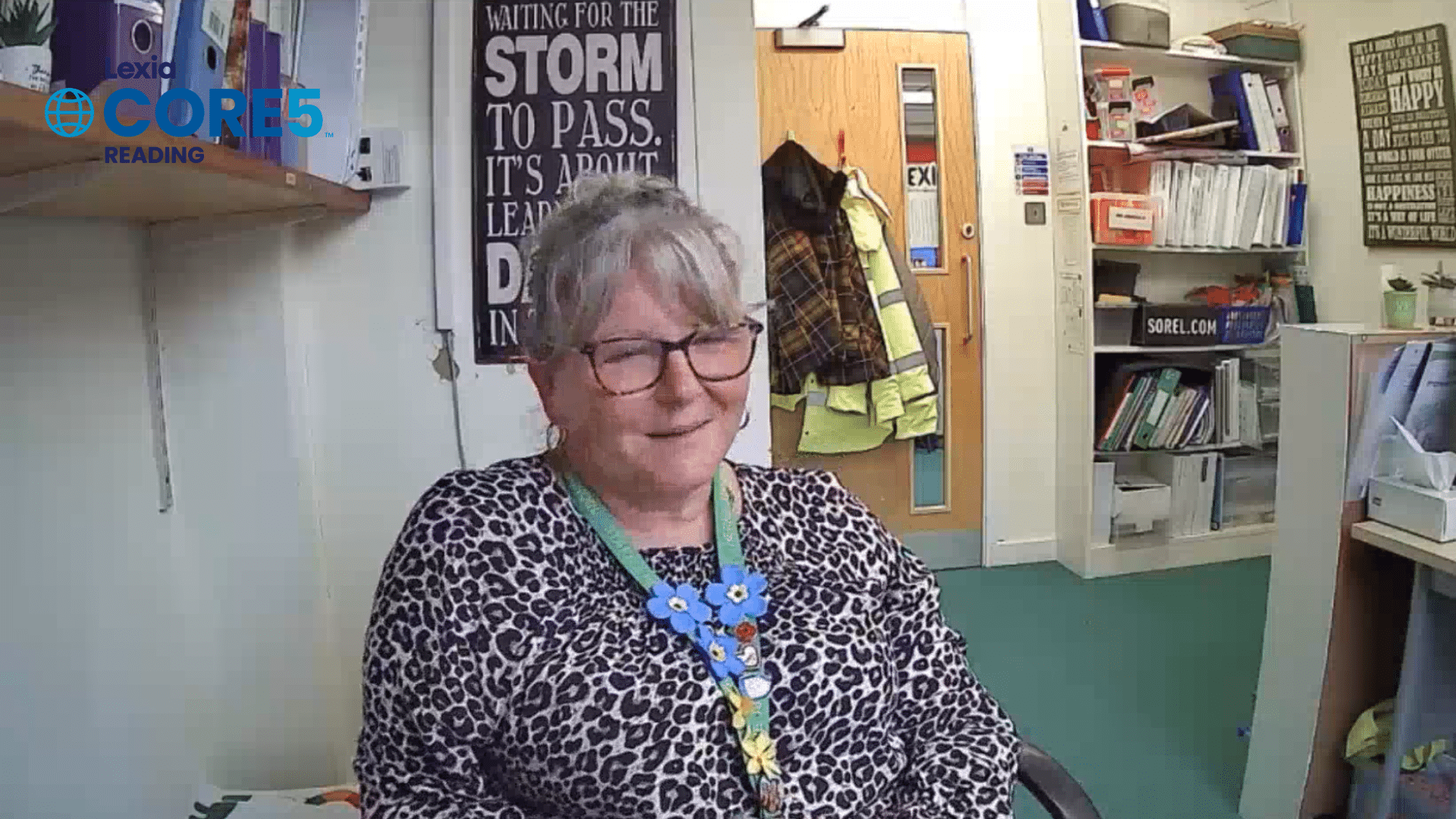
We had a fantastic conversation with Lynne Tandy, Lexia Coordinator and SEN Assistant at Herne Junior School. She shared her journey with Lexia, from first discovering it over lockdown to cultivating the positive, successful and energetic Lexia sessions she runs today with her pupils.
Watch and read the full interview below.
How did you first come across the Lexia program and what led to the school’s final decision to purchase?
When I came into the school and interviewed it was already in place. I had never come across it before and the school were keen to continue using it. It was a big learning curve for me to look into it and at the time, it was being used as an early morning intervention with Year 4 and Year 5.
I started in 2019 and, when COVID hit, I used that time to look in depth at Lexia and that’s when I found that all the doors opened. I started to properly grasp how it worked and where we could go with it.
As the children were working at home, I started up by contacting parents to try to encourage them to continue on Lexia at home every week. I emailed every child via their parents to let them know that I was checking up on their success, their minutes, completed units and if there was anything they were struggling with. I could email home the Skills Builders or Lessons and certificates. I would also put positive images and gifs in the emails. It inspired the children and I could see when I looked back on their progress how much more they had done because they knew I was monitoring it. That was how I first really hit Lexia.
From then on, as we gradually came back into school, my role was to deliver it to Year 4 -6 for 2-3 mornings a week each. Once I started that, I noticed that not completing Lexia every day was having an impact on their learning. I suggested instead that we have each year group complete Lexia Monday to Friday morning for a half term each. The children would come in early and we would provide a breakfast snack and complete some units on Lexia. I found it worked well to celebrate the units they were completing rather than their minutes. It would blow their minds finding out just how many units they were able to achieve!
What do you feel makes Lexia stand apart from other reading skills software products on the market?
I originally came from an infant’s school so I’ve never really come across a reading program like Lexia. Obviously, they do phonics in Key Stage 1 but Lexia is the complete package that breaks everything down. I often find that when they do their Auto Placement test, some of then can find their starting level fairly easy but there are some clear gaps that need to be plugged. I have found in the past that if those little gaps aren’t plugged, they can become wider, immeasurable gaps by the time they get to upper Key Stage 2. I feel that when they do Lexia in their first half term, they are plugging the gaps but they are also gaining confidence because they are achieving and setting themselves up to succeed. I think that is really important.
I think Lexia is just the whole package. I find the Skill Builders helpful too. I had a child that I was working with this morning who was struggling with High Frequency Words, so I gave them the Skill Builder to do at the start of the session as a warm up. Once he returned to the program, he was no longer struggling and he was able to move on.
How is Lexia used in your school? Please provide details of your daily routine and how you ensure that you reach recommended usage as well as which pupils use the program in school.
Each term we use an assessment tool that tests the children’s reading ages. We have a cut off for each year group and any children that are below that reading age will be identified as needing Lexia.
Most children are able to attend the early morning sessions, but for the children that can’t we still give them Lexia but I will work with the class teacher to fit it around their day in class. I will still monitor them in the same way and pop into class or leave them a little note letting them know that they are doing well and acknowledging the units they have completed. It really helps!
Describe the impact that Lexia has had on your pupils. Have you noticed a positive change in their motivation to succeed in literacy?
They are very keen to share their progress. In the past, I felt that some children were just sitting there struggling and not asking for help. But now, they ask for help and there is more positivity. They are keen to share their achievements with teachers and I will go into their classrooms to present their certificates and prizes, so that success is shared in the classroom. The other children notice and you can see them physically lift out of their chair because the feel so proud of their achievements.
We’ve got 2 children in particular this term who have moved up 3 levels and one has done 1119 minutes and the other one has done 936 minutes. It blows me and my colleague away! It is just an absolute joy to see their faces and their determination. Whereas before when they were only accessing it for 2 or 3 days, the continuity wasn’t there. I feel now we’ve got it right for us here at Herne and our children. We are definitely on a journey, a positive learning journey for them.
It’s a team effort, really. It’s not a stand-alone thing and we are not just on our own. It’s shared with the whole school, and everybody knows about it.
It was important that we got the teachers feedback when we increased the Lexia time and they were behind it 100%. They said that they could see that improvement and they were keen to maintain it. I know that the teachers next half term will do everything they can to ensure the children continue to get access to Lexia once they finish with me. Any spare time in class will be used and we send letters home, reminding them how to access it at home.
Can you give an example of a Lexia success that sticks out to you?
We had one young lady who came in very quiet. She needed a big boost of self-esteem. Now she bounds in every day. She has completed 1119 minutes on Lexia and has gone up 3 levels. She was recently off school for over a week due to illness and she was still working from home. When she came in this morning I was able to say; “Even though you’ve been poorly and its great to have you back, you have been working at home and that is impressive!” I love the way that no matter where I am and I can check at any time.
This is the first term she’s done Lexia, so it has been all new to her and her family, but they have really taken it on board. It’s nice that the family have encouraged her as well. It’s been a team effort to encourage and promote her reading.
How have you used rewards to motivate and celebrate success on the Lexia program?
We celebrate success every day! Both me and my colleague work together to bring humour and 100% positivity into the sessions. We encourage them to celebrate each other’s successes, so they all clap for each other and say well done when they reach the next level. They share it and we make it a total team effort. They respond to it well.
Any little thing that I can think off, I will do. I might print some stickers out that say ‘Ask me why Mrs Tandy gave me a house point.’ So that they can say ‘because I did so many units in Lexia today’.
Next Friday, I have a rewards session for them so I have some sensory play with some slime and bouncy balls. Before they log on they will have a quick sensory play session and they will go and do their Lexia.
At the end of this term, they will make a Christmas tree decoration that they can take home and share with family. It’s about showing them that there is a reward for their hard work. I think that is really important for them to feel that they are recognised.
I also do headteacher certificate so if they blow me away, at the end of term, I will give them a big certificate and they will go and share it with the Head, the Deputy or the Assistant Head as well because it’s important to share that success around the school.
It has got to be 100% positivity. I can’t let it drop. I want the sessions to be positive, energetic and enthusiastic all the time. It really sets them up for the day as well. They have got to leave the session in a positive frame of mind. If we notice that they are not feeling like they have achieved, we will sit with them and talk it through. Sometimes I will make visual prompts for anything they struggle to remember, like consonants and vowels. That way they can take it back and use it in class and transfer those skills.
How useful have you found the myLexia reports in terms of demonstrating progression and informing planning?
What I find interesting is all the detailed reports that you can get. I put it in date order and find the reports that can be adjusted to see the date, area of learning, the rate at which they are learning, their accuracy and whether they need support. I find it all really, really helpful. I love the way that no matter where I am, and I can check at any time. It’s an absolute bonus.
Before everyone comes in, I look at all the reports and check their attendance and how their minutes are going. If they are dipping, I can find ways to address it and speak to the children. Recently I had one child who did their auto placement activity and was placed lower than I was expecting. I let her work through and monitored her using the reports but found that she was zooming through. Using the data we decided together that, actually, should we try the auto placement test again? She improved and came back to it at a better level for her. Therefore, she’s going to start her Lexia journey much more confidently feeling like she is placed where she needs to be.
The teachers use the reports for parents’ evenings too. I will print out the parent reports so they can share it with the parents as well.
We are now trying to implement training for our Learning Support Assistants to help them understand it a little bit more and to encourage them to have a look because it is available to all the staff.
What main piece of advice would you give to a school that was just getting started with Lexia?
Give yourself the time to properly look at the program and how it works. If you know a school that is already using it or if you’ve been recommended it by another school, it’s good to have a look at the results they have had. Before you start, it’s good to start off with a small group of children or even create a test account for yourself so you can really discover what is available on Lexia because it is so vast and varied. Giving yourself that time is important. You need that personal input time to understand the content and be able to deliver it properly to promote confidence and that positive learning experience.
I felt that my Annual Review with LexiaUK was really helpful as well. It’s something that I hadn’t engaged in before. I had had the initial training, but I found the chat about our Implementation plan helpful to enable me to target. My adviser emailed me a copy that I was able to take to my review with SLT and use to create goals for my personal achievement.
What feedback have you had from your Lexia pupils?
They absolutely love it! I have just sent letters out to Year 5 who will be starting Lexia next half term. I think they got a bit confused because they came in early this week ready for their breakfast snack, They couldn’t wait to get started! I’ve given them their details and completed auto placement with them already so they can do it in class if there is time.
We’ve just stopped one 7-week block of Lexia with one group, and they are constantly asking ‘when are we coming back?’ Even if they are coming in early and the weather isn’t so great, they still come in with enthusiasm and just crack on. There is no hesitation. I have to be there at the door before the Lexia time starts because I know they are going to be early!
Is there anything else you would like to add regarding why you think Lexia has been a success in your school?
I think changing the timetable to it being a daily program has made a massive difference because of the continuity. When they finish in the morning, they know where they are up to when they come back the next day.
I also make sure to keep an eye on the progress bars in the program. They have to complete the green line before they log off so they keep their progress. It’s a good way to end the session too because they have ended on a positive and they can come back the next day knowing exactly where they are up to and apply learning from the day before. I’m always talking about the green line and use it to encourage them to keep going. They pick up on everything that you say so it has to be positive!
Step into the Literacy Spotlight

This month our Star School is..
St Alban’s CE Academy, Wolverhampton!
We spoke to Attiye Passey who is the Reading Lead and has been using Lexia with all pupils in school.
How is Lexia used in your school?
We use Lexia slightly differently to how the program was initially introduced. We’re based in quite a deprived area. We’ve got lots of children who were very affected by COVID and, I’m sure like every school, we had significant gaps with some of our children. So, we’ve used Lexia to support all children rather than just a group.
All children work four times a week on Lexia and the class will be split so that the class teacher has a smaller group of children to target their specific needs. This can be happening while the rest of the children in the class work on the online tasks that are completely based on their ability.
Part of the teacher’s role from here is to, while they’re planning, look back at the Lexia progress and what the children have struggled with to then tailor make their next set of lessons.
We could do this as part of whole class reading but it’s a little harder to target all of their gaps, particularly in our school were we have a diverse range of needs. A program like Lexia allows us to take a more focussed approach.
Teachers use Lexia and across the week and children have access to it when they come in first thing in the morning. We are also very lucky to have an amazing library here, so we target key groups of children who we know need that extra usage or might not have that opportunity at home.
Have you noticed a positive change in pupils’ motivation to succeed in literacy? Can you give an example of a Lexia success that sticks out to you?
Yes, massively! First of all, they love Lexia!
Some of our reluctant readers are the first ones on Lexia every single day, which is amazing. As a school, to be able build that enthusiasm up has been very special to see. All the teachers have been very motivated as well. Our jobs are hard, but I think, because they feel as though they’re being given that extra time to focus on the needs of their children and to go into detail on what a specific group of children need in that session without worrying about jumping to all the eight different places they need to get to in the class.
On average, within the first 5 weeks, most children had made at least 2 months progress which was massive for the school! We noticed our bottom 20% of children, our more vulnerable learners, have made significant progress in starting the program. We’ve now got more children the potential of reaching greater depth as well. So, Lexia has managed to target all learners.
I’d say the biggest impact has been children’s enjoyment of reading, but also teacher workload. It feels more manageable and, even though we’re still working just as hard, we’ve now got artificial intelligence also supporting those children, so nobody gets left behind. It’s made a massive difference to the environment and the feel of a reading lesson rather than feeling like we’re racing to a finish line.
For example, we had a child who is in year five and they were accessing spring term reception expectation of reading initially. He could identify sounds but wasn’t necessarily mixing them together and blending them. But now, he’s reaching end of year one reading skills. He’s on stage 5 now and his confidence has just come on leaps and bounds!
Generally, the confidence of children, particularly those who liked reading but knew it wasn’t an area that were comfortable with, they’ve really come out their shell and they’re just giving things a go! The moments on Lexia where it recaps tricky words and things like that, as well as the repeating games to secure and embed knowledge. They’ve loved those and it makes them remember it.
In addition, we’ve noticed the difference in writing across school as well since then. They say that, if reading is breathing in, writing is breathing out. You must have the two together. If you are not exposed to a wide range of text and that rich vocabulary, you are not going to learn to write. We have found the two to be marrying up much more in school, which is lovely to see.
How have you used rewards to motivate and celebrate success on the Lexia program?
We have only introduced the reward system fairly recently because we found at the beginning, they’ve just loved it. There’s not been anybody who’s been reluctant. We always praise in assembly.
I take some time every month to look at the progress data of each class and feed back to the class teacher to encourage them to praise their children. This is what they’ve done.
We are a very small school, so I am lucky to be able to get to know all the children myself. This means that if I am walking down the corridor and I see a student who I know is making good progress, I can say “You’re doing an amazing job on Lexia!”. It is that verbal praise that is having a big impact at the moment.
We’ve just had World Book Day, so we’ve just ordered a lot of free books ready to give children as prizes. We have a Reader of the Month each month in Key Stage 1 and Key Stage 2 which is based on their Lexia progress and their individual journey on Lexia. This is so we can celebrate all learners and not just those that are meeting their age-related work.
How useful have you found the myLexia reports in terms of demonstrating progression and informing planning?
Really good. Initially, I started off by looking at the data myself and then sharing the relevant information with staff and condensing it to make sure that it quickly accessible.
Our next step will be to arrange myLexia training for all staff next half term, so they can understand the detail of the reports. I’ve found it incredibly useful to be able to see if anything’s been highlighted. It’s allowed to identify groups of children that need specific intervention and plan accordingly.
Being a small school, staffing is very slim, but the reports help us to pick up on the students’ needs and add these into the school day where we can. It has been very helpful in that sense to inform our daily planning.
Being able to see it clearly on paper, where they started compared to where they are, is just incredible! I remember the first report I printed, I could not believe the progress they had made on the program!
How have you expanded Lexia into home-use? How have parents responded?
The parents really like it. Parents have been extremely impressed with it.
We’ve got a few families who might not have the access to it because they don’t have access to the technology. But as I said, because we’re targeting those pupils in school at lunchtime, all children have a similar opportunity.
We’ve got some kids where Lexia is all they do at home! They have pride in their work on the program which is great for us! It’s been a nice experience for them to share that with their parents as well.
We’re going to look at offering some walk-in Lexia workshops for parents in the Summer Term just so they can see what Core5 is about and how it works. We’ve sent out the letter and we’ve given them that sort of support but, as we expand it, we’re going to start looking into that so parents know how best to support them outside of school as well.
Is there anything else you would like to add?
To be honest, I think the main thing has been how open LexiaUK have been as a company. I was very honest with my Software Consultant and made her aware that our children have a very significant need. She was so understanding and flexible and was able to listen to our needs and come up with a package that supported what we want to achieve with the program. Her support was immeasurable, and I think that is quite rare to find in a company. She was totally understanding of our school situation and that has really benefitted us implementing it using the model that works for us. We are very grateful for that.
What feedback have you had from your Lexia pupils?
Generally, the feedback has been extremely positive. Lots of them very excited by it. They love all the levels. We were worried initially that some children might looking over shoulders and comparing themselves to their peers, but they don’t seem to do that. They are just generally very engaged and very excited by it and lots of children will often talk about their progress too. I popped into the library the other day and some children were excited to tell me what they had been working on and which sight words they were learning. It’s been generally a positive response. I think it made them see reading in a completely different light. They have understood how reading can unlock their imagination! Those that have found reading a book quite difficult have been given a new confidence to have a go now.
Step into the Literacy Spotlight

Our Star School for March is…
Pembridge Hall School, London!
We spoke to Mhairi Paton who runs Lexia sessions with the school’s Year 2 and 3 cohorts. She told us how they have engaged their Lexia pupils across the whole school and embedded the program into their school life.
How did you first come across the Lexia program and what led to the school’s final decision to purchase?
We are a girls’ school and decided to purchase Lexia after we found that a lot of our girls were coming back after the Covid lockdown with quite big gaps in their learning.
We wanted to find a program that did not necessarily need to be teacher led but could be supportive to teachers. Our SENCO was recommended the program by another school who was already using it.
What do you feel makes Lexia stand apart from other reading skills software products on the market?
All of the teachers found it very user friendly and the kids were very engaged with it. Those were the two main things we were looking for. It really supported their learning but it was engaging enough not to feel like a formal lesson. Engagement was a big factor, especially as we are asking pupils to come in at 8:15am to complete their Lexia time. It’s got to be fun!
How is Lexia used in your school? Please provide details of your daily routine and how you ensure that you reach recommended usage as well as which pupils use the program in school.
We use data to select our Lexia cohort. The whole process is very data-driven so we work out which pupils across the year groups require the additional support. We have assessments every term so we can be fairly flexible. If one of the girls meets their age-related expectation, then we can take that pupil off the program and use the license with another pupil. However, I must say that when we told the parents we were taking them off of Lexia we found that the parents didn’t want them to stop because the girls were getting such a benefit from it! It was working so well, they wanted to keep it.
We run Lexia sessions first thing in the morning before school. We invite pupils to come in early 3 days each week to complete Lexia time. I set all the laptops up with their login cards so all the girls need to do is come in, put their headphones on and they’re off! At a minimum they complete 30 minutes each session but I can usually keep them a little longer before they go back to class and start the school day.
The program itself recommends the usage for them and I have found that if they are reaching those targets, it really does make the difference to their progress. You can really see the difference in progress between those that are coming in only once a week versus those that are consistently reaching their usage targets. We are also encouraging parents get pupils logging in to Lexia from home as well. This seems to be having an impact and it has a knock-on effect. Those that are logging in are getting certificates and praise, so it encourages the other girls to try and complete Lexia time at home too.
Describe the impact that Lexia has had on your pupils. Have you noticed a positive change in their motivation to succeed in literacy? Can you give an example of a Lexia success that sticks out to you?
I have definitely noticed how enthusiastic they have been with it. I have noticed a few occasions when a student might have struggled with something in class and once it pops up on their Lexia program, they have gotten the practice they needed to complete it successfully. The fact that they have then been able to go back to class and overcome those little challenges has been great!
We had a girl who was really struggling with question marks, so I decided to manually move her to that level on the Lexia program and set that as a task for her. In the weeks that followed, her class teacher had said that there had been an improvement in her work after completing the practice on Lexia Core5. When they later revisited the topic, they had found that clear progress has been made in this area in the long term too. It was great to hear that from the class teacher!
How have you used rewards to motivate and celebrate success on the Lexia program?
We have a whole school assembly where we share a number of awards for sports and academic success, so Lexia certificates are shared and presented then.
If the girls achieve a certificate while in a Lexia session, I make sure to print it immediately for them. This means that they get the instant gratification of their achievement. They are always very proud to go back to their class after the session to show off their certificate!
We have also found that the certificates are very helpful for parents too. The way in which they break down everything they have completed in their level has been valuable for parents to see.
I have seen the printable stickers in the Core5 Resource hub so my next step will be to print out some stickers to give out in the sessions.
We have found that they program provides the girls with lots of intrinsic motivation as well. A lot of the girls have picked up on the visuals along the bottom of the screen that tells them how many units they have completed. This element has really driven them to want to get the next level, especially when they can see that they only have one or two units left!
How useful have you found the myLexia reports in terms of demonstrating progression and informing planning?
They are so visual, so they have been very helpful. When we have been speaking with parents who may have had concerned about what they were gaining from these additional morning sessions, we have been able to print reports to show them exactly the skills they have been gaining over that time. It can really drive usage as well. We can clearly see a trend between those girls who are meeting their usage and the progress going up.
It has been great to share these reports with class teachers as well, I can simply print the reports and send a PDF which details everything a student has been learning. It’s been very handy to give the teachers that instant feedback.
What main piece of advice would you give to a school that was just getting started with Lexia?
My main tip would be to have everything set up for the Lexia session before the pupils come in. Particularly for younger pupils who can spend a bit longer logging in, having everything ready means that they can come straight in and get on with it! It really helps us to maximise the time they have on the program.
Another tip I would give is to share and celebrate every little bit of progress you are seeing. Getting that recognition in front of their class and the whole school has really given them a boost. There is a positive atmosphere in our Lexia sessions to the point where we have other pupils in school have been asking if they can join! For me, this just shows that they are really enjoying it and it is not just seen as an additional lesson. They’re seeing it as a fun session.
What feedback have you had from your Lexia pupils?
They absolutely love it! They get really excited about it. There are a few girls in school that I don’t tend to see at other times of the day but when I pass them walking around school, they are always keen to tell me how they have been getting on with Lexia and share their excitement for the next session. Because it is a personalised program, we have also been able to complete sessions with multiple years at once, so they have formed friendships across year groups and become a little Lexia crew! It’s been lovely to see.
Do you have any additional comments on why you feel Lexia has been successful in your school?
I think for me, it is the independence that the girls have been able to have over their learning. Once they get into the flow and the routine of Lexia, there has been a big difference. They can clearly see and track their own learning which is really driving them to get to the next stage and progress even further.
I have also noticed an impact on their Digital Literacy skills. They are becoming much more familiar with logging into the computers and understanding how to navigate to the website or open and close a page. We don’t always get the chance in lower school to practice those skills so having them learn this on top of their literacy has been a bonus!
I think for a teacher, having 22 girls come in for an intervention session all at once could be quite overwhelming, but with Lexia, it is actually a joy! They can just come in, put their headphones on and they are all working on personalised, targeted work. That give me the time to monitor and make sure they are all supported.
Step into the Literacy Spotlight

We are thrilled to announce our first Star School of 2024 is…
Coombe Road Primary School, Brighton!
We spoke to Sheila Walker, who leads on the Lexia program in school. She told us how the Lexia program has been a longstanding fixture in their school and how they have been able to maximise Lexia by using it with their entire Year 2 cohort.
Read the full interview below.
How did you first come across the Lexia program and what led to the school’s final decision to purchase?
We are going back a long way now! I looked into it and, after doing some research and reading some case studies, it seemed like it would have a good impact. Looking into the costs as well and pricing it out per pupil, it appeared to be excellent value.
Once we rolled it out in school, we quickly saw the impact it was having on the children and their progress with reading, so we have stuck with it ever since! We have been using it for about 6 or 7 years now!
What do you feel makes Lexia stand apart from other reading skills software products on the market?
I think the graphics are superior when you look at other providers and the children are really engaged with it. Generally, it reached the majority of all of our children over the years both in terms of engagement and the results. Once children get into the routine, they really love it. It’s been embedded in our day to day school life really well. Parents are aware of it as well. It’s really just part of the school now!
Even with the difficulties with budgets in schools at the moment, it is well worth keeping Lexia because it’s effective.
How is Lexia used in your school? Please provide details of your daily routine and how you ensure that you reach recommended usage as well as which pupils use the program in school.
Currently we are using Lexia with 23 children in Year 1 and 24 children in Year 2. That is the whole of our Year 2 cohort and all but 5 of Year 1 who would struggle to access the system until they reach a higher level of reading.
In our termly progress meetings, we will look at the school data and identify if we want to put any additional students onto Lexia, if they are ready. In these meetings, we may also decide that some children have flown through it and caught up to be age-related in reading so we will remove them from Lexia to free that licence up for another pupil. We can be flexible in that way.
We have a timetabled Lexia slot for each class in the IT suite every day. With each class we have 4 groups working on the online program while 1 group takes part in guided reading with their teacher. This rotates each day so that every pupil gets at least four x 30 minutes sessions per week on average.
For the past 3 or 4 years, we have provided Lexia to the whole of Year 2 and that has had a good impact as they have gone into Key Stage 2, giving them a good grounding of phonics and reading skills. This year, we have also decided to concentrate more licenses to the majority of Year 1 as well to extend that impact. Our hope is that after 2 years of Lexia, the majority of our pupils will be flying by the time they reach Year 3! We have found that using the program with a whole class has been much easier to implement than having just a few pupils from each class. This way we know we are getting the full impact from it.
Describe the impact that Lexia has had on your pupils. Have you noticed a positive change in their motivation to succeed in literacy? Can you give an example of a Lexia success that sticks out to you?
Yes, when a child in the class achieves their next level, we make sure that we celebrate them. They get claps and cheers from their class during the session and a certificate is printed for the Headteacher to present in Celebration Assembly on Friday. They are all very proud when they receive their Lexia certificates and enjoy taking them home to share with parents.
One thing that has really helped all pupils is that, it doesn’t matter which level they are on, the progress is celebrated nonetheless. The children are all genuinely pleased for each other’s achievements so it has helped create a really positive atmosphere.
We have also seen the impact during our termly pupil progress meetings where each child is discussed. It has been really affirming to see the progress seen on the myLexia reports corresponding with teacher’s observations. Even if there is a difference, it can really help us identify where additional support may be needed. On the whole we are finding that it is speeding up their progress to where they need to be.
Can you give an example of a Lexia success that sticks out to you?
I had a child that I used to work with in Year 2 when I was a specialist TA. I worked one to one with pupils on their literacy skills and this pupil in particular had and EHCP for their Speech and Language needs. We began using Lexia as part of his intervention program and by the end of Year 2, he could read every key word right up to year 6! He also got 40 out of 40 when he retook the Phonics Screening test so he was one that really stood out to me as one that Lexia has made a big difference to.
How have you used rewards to motivate and celebrate success on the Lexia program?
In addition to the certificates and celebration assembly, we have found that parent consultations have been effective for motivating pupils. Sharing successes with parents has been helpful for keeping the children going on the program. We also have a house points system so teachers can give out points when a pupil has really excelled on Lexia.
Pupils are generally very motivated to engage with Lexia. They love all the games and graphics that come along with it. They are always wanting to know what the next level’s theme might be so there is a lot of motivation built in.
How useful have you found the myLexia reports in terms of demonstrating progression and informing planning?
I keep an eye on the myLexia reports and will let the class teacher and TA know when any pupils require any further support. I also download the Lexia Lesson Plans and Skills Builders and provide the appropriate resources to staff so that they have everything they need to get pupils past the point they are struggling with.
This is important because we don’t want the pupils to begin to lose motivation if they are getting stuck on a particular activity. They TAs are also good at spotting when a pupil needs help as the progress bar changing colour at the bottom of the screen is an easy visual to check as they are walking around the IT Suite.
This approach works well as I can use the reports to inform teachers and TAs if children need additional support, and they can decide the best course of action for each pupil. In some cases, it can be that simply sitting with the pupil to support them with the online activity is all that’s needed, while for others, 5 minutes away from the program to work on a quick paper-based activity will get them back on track, they get back on the program and then they’re off!
What main piece of advice would you give to a school that was just getting started with Lexia?
I would probably recommend that they focus on a class or two at a time when starting out. Getting the routines in place before introducing it to more pupils.
I would also recommend that it is timetabled that pupils get slightly more than their recommended weekly usage on the program. This really helps to give their progress a good push!
Finally, I would recommend having someone, like myself, to oversee the program and discuss results regularly with teachers. This helps both teachers and pupils see the impact of the program on their progress which can help spur on its use even more.
What feedback have you had from your Lexia pupils?
We had a child come into our office this morning and say to the SENCO, ‘I’ve just completed my Level 8 on Lexia yesterday and I haven’t had my certificate!” I had only just printed off the certificates, so I replied to the pupil, “I think you’ll find it’s just there on that desk!” They are really proud of their achievements, so they are really aware when they are due a certificate. Generally, they are all really positive about the program – I don’t remember the last time a child said they didn’t like Lexia.
Thank you for speaking with us, Sheila! Look out for your Star School certificate and book voucher arriving soon!
Step into the Literacy Spotlight

This month’s Star School to be featured in our Lexia Literacy Spotlight is…
Smithton Primary School, Inverness!
We spoke to Emma O’Donnell, who leads on the Lexia program in school. She told us about the lasting impact that Lexia has had across school and provided some insights into how the myLexia reports have helped to promote best practice.
How did you first come across the Lexia program and what led to the school’s final decision to purchase?
We have previously used other literacy programs and the one we used previously we felt was quite juvenile for a lot of our pupils. We were looking for something that would, not necessarily solely appeal to our upper stages, but would capture their interest as much as the lower years.
Promoting autonomy of learning was very important for us so we started to trial the program at the end of the previous school year. We also wanted something that benefitted and supported teachers while still giving pupils that ownership of learning. After seeing it in action in Beauly Primary School we recognised that Lexia provided all those things for us.
What do you feel makes Lexia stand apart from other reading skills software products on the market?
At the time we were initially rolling the program out, I was the Additional Learning Needs teacher at the school which meant I was very well placed to take ownership of its initial utilisation in school. As a ‘data head’, I really liked the reports and being able to clearly see how each child was progressing. The traffic light system was particularly helpful to see at a glance which pupils which pupils are on target wand which need further support.
The resources that come along with it are fantastic as well. The Lexia Lesson slide decks have been great and I really like how the program breaks down explanations for the children. They are offered lots of scaffolding where they need it and there are plenty of opportunities for focussed interactions and teachers can come in and provide that one to one only when it’s needed.
It’s these features that I really got the most benefit as the Additional Needs Teacher. I could use the lesson plans that were provided and the slide decks were great since they integrated with Google Classroom that we use in school. They are nice, interactive resources that we have in addition to the online program.
One final thing that stood out was the opportunities for school to home learning. We regularly are asked by parents about different ways that they can support their children and, in addition to the homework grids we send home, Lexia allows us to identify a focused part of their literacy needs that the program can provide support and practice in the form of the online learning or in a Skill Builder. The wide range of learning resources that students can access from home to support independent study, such as the Lexia Lesson Plans and Skill Builders, make a positive difference in their approach to reading in the classroom.
How is Lexia used in your school?
Every teacher and every class is unique but what we have found that the usage targets that the program provides to each student has supported that consistency across the whole school. There are two main points in the day where Lexia is normally undertaken. The very beginning of the day has been really beneficial for our younger pupils.
Teachers have their Chromebooks and headphones ready in the classroom for when they arrive at school and they can get started immediately with minimal disruption. In some classes further up in school we have ERIC time (Everybody Reading In Class). That would also be where we would have our Lexia time as well, so a group of pupils could be reading independently while another group works on Lexia while supported by a member of staff.
The flexibility of Lexia means we can tailor use according to the needs of the pupils at different phases.
What has been the impact of Lexia in your school? Could you give an example of a Lexia success that sticks out to you?
Absolutely! One thing I will say is that, giving students the autonomy over their learning, particularly in P6 and P7 (Year 5 and Year 6) has been particularly effective. We have 1 to 1 devices in school so every child has their own device. With this, we can offer pupils the opportunity to do extra Lexia time at home and, encourage them to complete some more minutes.
We had one child who I taught myself in P6, he is now in his first year of Secondary. He was not expected to achieve his level for his age and stage. He had significant dyslexia and significant literacy difficulties throughout primary school. I got him started on Lexia in Primary 6 and last year (Primary 7) was his first full year of using Lexia.
He was assessed initially with the Auto Placement activity at being at a Year 3 level and he was the only person in our school to finish Lexia completely. He reached his age and stage and beyond! He worked so hard despite being incredibly conscious of his dyslexia. He surpassed all of our expectations!
We have significant literacy difficulties in our school so it is not often that pupils are flagged by myLexia with the green ‘On Target’ tag and he was one of the only pupils who was flagged as green.
That’s one of the things I really like about myLexia. Sometimes seeing something as simple as a line graph, plotting that trajectory the student is on is enough to show them what they are achieving. When they get a bit older, they may not all be excited about the certificates, so can be ‘too cool for school’, but showing them that data can promote that intrinsic motivation they get from seeing their skills increase.
Being able to present the Lexia Completion certificate in assembly, particularly with this student that had such difficulty with their literacy, was a special and momentous occasion. That was a real achievement! It helped us to give him that little boost of confidence that I know has given him a really good start to high school.
What I will say is, we saw that success so quickly because we had teacher buy-in. The P7 teacher understood the importance of Lexia, understood the importance of timetabling it, understood the importance of the Lexia Lessons and Skill Builders and utilising them. It’s only because we got teacher buy-in that we could achieve that.
How have you used rewards to motivate and celebrate success on the Lexia program?
The certificates are a big part of it. We give them out in assembly and the teachers are keeping an eye on the reports and celebrating those successes. We use Google Classroom which means that we can communicate between home and school and post successes there.
In addition to those main reward schemes, we have found that those smaller ways to recognise effort and success have a big impact. As the Additional Needs Teacher, I could go into the classroom and provide students with that extra validation. Mentioning that I could see how well they had done and the effort they were putting in. That constant communication with students and teachers promoted those small incremental efforts.
How useful have you found the myLexia reports in terms of demonstrating progression and informing planning?
I started keeping a tracker myself using the myLexia data. I could analyse the data for each pupil, rate the level of their progress and even averaged the minutes per school day that the students were working on Lexia. It sounds pedantic but it helped keep the bigger picture in mind.
It’s great if a pupils has been able to meet all their minutes one week but if they have not logged in for the previous two weeks, that actually averages out at very little per day. If we want to see the benefits of Lexia then we need to make sure that pupils are consistently getting their 20 minutes per day.
myLexia data really helped with accountability too. Teachers are able to view the data and see any areas where progress has slowed down. This then prompts further questioning between both staff and pupils of areas where additional support is needed or is anything else, such as attendance, causing this impact.
It really helps us see the bigger picture and look at everything holistically. Having all this information into these trends can help us determine the best cause of action for that teacher or that student.
Usage reports on myLexia have also helped us to hold teachers accountable to ensure our licenses are used to best effect across the whole school. Making all teachers aware of the importance of utilisation has increased buy-in. As a result, we have seen a 13% increase in reading attainment last year.
Sometimes teachers just need that data to clearly see how well a child is doing and, what I like, is that you can see how many times a child has attempted something. It can bring any slight issues to light. I also seen instances where a class in general have shown to have difficulties with syllables, for example, and the class teacher has been able to do a whole class lesson to reinforce that skill.
Why do you feel Lexia has been successful in your school?
We have really embraced Lexia. I am fairly new to teaching, and having something like Lexia that gives you hard facts and a very clear focus into where pupils need support, I have liked. I like that we can specifically target and help children in focused areas. It is not just like “they are struggling with comprehension” which is a broad area, it is actually giving information about this one specific thing and providing a focus on that. I’ve liked that we have been able to work with a wide age range of pupils and Lexia has allowed me to work with them all in different ways.
We have also been able to provide support to teachers in terms of homework tasks and provide better parent support. I don’t think we utilise the Core5 Resource Hub as much as we could so this is definitely a target for this year because it is fantastic!
Our head teacher was pleased to hear that our reading attainment had come up by 13% and I can only put that down to the only difference that we’ve had, which is using Lexia and having somebody focused on using it. It might not be the sole reason, but it’s definitely a good significance that it was the case!
What feedback have you had from your Lexia pupils?
They have liked it. As I mentioned earlier, programs we have used in the past they have found quite baby-ish so they haven’t shown much enthusiasm. They really like Lexia though. They like the interactivity and that they can see their progression. They take ownership of their learning and set themselves targets such as trying to finish all the units in an activity. They are spurred on to keep going which has been positive.
Step into the Literacy Spotlight

This month’s Star School to be featured in our Lexia Literacy Spotlight is…
St. Paul’s CE Primary School, Newcastle Upon Tyne!
We spoke to Colin Harrison, who supports pupils with SEN and delivers Lexia sessions to pupils across the school.
He told us how Lexia Core5 has had a profound impact on some of their pupils with the greatest needs and how it has supported pupils with varying ability levels.
Read the full interview below to see some of the wonderful comments he made about how the Lexia program is working in their school.
How did you first come across the Lexia program and what led to the school’s final decision to purchase?
We first came across Lexia almost 15 years ago at an SEN Network meeting, so we have been using it for a very long time!
Historically we have used it with SEN pupils but have recently widened use to include whole classes. We rolled it out with Year 3 last year and it worked really well! I worked with the class teacher during literacy lessons, the teacher would take half of the class, I would do Lexia with the other half of the class and then we could swap over. Particularly in writing lessons, it worked very well!
Those children have continued with Lexia use into this year and we have rolled it out into the new Year 3 class as well. We’ve also just put licences on for Year 4/5. They’ve just had a go of it so they are ready to start summer use over the holidays.
Since it was so long ago, I can barely remember what led to the school’s decision to purchase! I think it is how individualised it was and still is! It’s really interactive and we were confident it could specifically address student’s knowledge gaps.
As we initially rolled it out with SEN pupils, we felt that the program allowed us to reach a larger cohort of pupils as we have quite a high proportion of SEN pupils in school. Lexia allows us to meet each of these pupils where they are at.
What do you feel makes Lexia stand apart from other reading skills software products on the market?
The targeted approach is a real stand out for me. Children are able to get to work on exactly what they are struggling with.
The children love it too! Last Monday I was giving out the letters for home use and I had children cheering! They are all so excited that they can use Lexia at home over the summer holidays this year.
How is Lexia used in your school? Please provide details of your daily routine and how you ensure that you reach recommended usage as well as which pupils use the program in school.
Initially, I ran 2 or 3 groups a week where we have 6 or 7 students in a group completing their Lexia time. These smaller groups usually consist of students with SEN but I also open these groups up to any students that the teachers identify as needing additional support with reading skills.
We also identify students that have failed the phonics screen retake in Year 2, they will be picked up automatically with Lexia in Year 3 to address those phonics gaps.
In addition to this, we have also decided to roll Lexia out to whole class groups. We use Lexia in a class setting during Guided Reading time in Year 3 and Year 3/4 and I am hoping to roll this out in Year 4 and 5 as well.
As well as Guided Reading sessions, these classes also get the opportunity to go on Lexia for 30 mins each Monday at the end of the day.
In Year 5 and 6, the students are a little bit more independent so we can instruct them to collect a laptop when they come in from their lunch and do some Lexia work. I think giving them this ownership of it has been a great idea and we’ve seen a lot of progress on the program since then.
Before the pandemic, I ran a computer club with some children from Year 5 and 6 part of the session was doing Lexia. I also ran a reading club for children in Years 2 and 3 where we read stories and the children spent some time on Lexia as well.
We have just rolled out Lexia home summer use from Years 3 to 5. I am looking forward to September to see what progress our children have made!
Describe the impact that Lexia has had on your pupils. Have you noticed a positive change in their motivation to succeed in literacy?
Progress across the board has been good. Our school is in a vulnerable area so there are a lot of challenges but I think Lexia really helps bridge the gap with our pupils. The majority of pupils are very positive and motivated with the program. Even since rolling out home use on Monday, I’ve had a child coming up to me on the playground telling me about how they have been on Lexia last night at home. It’s lovely because some of the students that have taken to it are not always the ones you would think!
It has promoted independent learning and helps students to plug those specific gaps. I have sat and watched some pupils working and looking at what they can now do, it’s amazing to see compared to what they could do at the beginning! Some children struggle with just sitting and writing and reading, but having something like Lexia that is interactive has brought out the best in them. And they see it as fun too! They don’t realise they’re learning in the process.
Can you give an example of a Lexia success that sticks out to you?
I was amazed by a child in Year 3 that has made outstanding progress with Lexia. They are a child with Autism and their support worker agreed to try Lexia to see if it had the impact with them. This child has made the most progress this year and has gained about 4 certificates so far! This student is non-verbal and only has a few words but ‘Lexia’ is one of their words! The support worker told us recently that Lexia is one of this child’s ‘happy places’. They are just so content when they are on Lexia.
The progress has been so quick as will, I was absent from school for 3 months and by the time I had come back he had already gained 3 more certificates!
How have you used rewards to motivate and celebrate success on the Lexia program?
When they finish an activity in the program, I will give them a star and when they complete a whole level, they get 3 stars. Of course, they will also get their Lexia certificates in assembly. We have teachers’ special awards as well so I always tend to celebrate successes I am seeing on Lexia at all levels.
It has been a challenge removing some of the stigma that surrounded the program as we previously used it with only the lowest ability students. Since rolling it out more widely, we have been able to remove that stigma and have turned the students’ perceptions around. It is a program that can support all abilities. Some of the more able students regularly as if they can join Lexia groups now!
How useful have you found the myLexia reports in terms of demonstrating progression and informing planning?
I tend to log into myLexia 2 or 3 times a week. As I typically work with small groups, I have found it really helpful to go into the detail and see if students have any additional needs.
In a whole class setting, if I see a child has been flagged for a Lexia Lesson, I have a little bit of time each week where I can go and get that child and complete a little session to support them with whatever they are struggling with.
I also use the reports to identify who I am going to sit with on the next session. Sometimes sitting with them and talking them through the online activity is all that is needed. The Lexia Lessons are good as well if need to bring them out at any time.
The Skills Report is one I find particularly helpful with our pupils with SEN. We have files in the classroom with IEP and information for each of our SEN children so every term, I will put a copy of the skills report in as well. This means the teacher knows the specific skills they are struggling with and this can inform their IEP next term as well.
On the whole class level, teachers all have access to a myLexia account so they can check in on their own classes as well. I showed the class teachers a bit more of the resources available in myLexia on the Resources Hub during a staff meeting. The staff thought they were brilliant, especially the Close Reads for Year 5 and 6!
What feedback have you had from your Lexia pupils?
Very positive! The children are enthusiastic about doing Lexia. They enjoy it and I don’t think I know of anyone that doesn’t like working on the program. They are always saying, ‘Oh, I only have one unit left before I finish the level!’ so, they are self-motivated which is lovely! I am hoping to build on this success and complete more whole class sessions with Year 3 up to Year 5.

This month our Star School is Crail Primary School, Fife!
We spoke to Gary, who is a teacher at the school. He told us how Crail Primary School has benefitted from rolling Lexia out across whole year groups!
How did you first come across the Lexia program and what led to the school’s final decision to purchase?
Personally, I have previously used it at another school. I was teaching a P7 class there and I noticed that the learners who were on Lexia really enjoyed it and got a lot out of it. When I came to Crail and Lexia was first mooted as a possibility for us, I was quite excited at the potential. Our Headteacher, Natalie, trialled the program and then we were able to purchase 50 licenses to target those with the greatest need in school.
What do you feel makes Lexia stand apart from other reading skills software products on the market?
I liked the fact that it was individually tailored and that students could progress at their own speed. It was very adaptive in terms of flagging up areas that need more reinforcement. I liked the way that it has the recognition built in as well not just in terms of the program itself but the certificates. The students have really responded to these physical aspects of the program as well.
How is Lexia used in your school? Please provide details of your daily routine and how you ensure that you reach recommended usage as well as which pupils use the program in school.
We use it with every pupil in P2, P3 and P4 as well as those in P5 to 7 that would benefit most from it. This is so we can know we are making the most effective use of the licenses. In terms of usage, each class has tailored Lexia time. Some classes have a timetabled system while others have a rota of groups that use Lexia. In the case of P5, 6 and 7, where there are fewer pupils accessing Lexia, they can do a little each day. We have also communicated this with parents and the fact that the children would benefit from accessing it at home. We’ve made sure to let them know that they don’t need to do it in one big chunk. Because Lexia records all usage, we can really leave it up to parents whether they do a 30-minute slot or a few 10-minute slots. Those that have been accessing from home have really seen the benefits.
Describe the impact that Lexia has had on your pupils. Have you noticed a positive change in their motivation to succeed in literacy? Can you give an example of a Lexia success that sticks out to you?
We have definitely seen a positive change and one of the things I have seen develop over time is their attitude towards Lexia itself. There was a bit of a spread in terms of their initial reaction to it when we first started. Some instantly thought it was really good and really enjoyed it but for some it was a bit of a harder sell. I thought the way that the program is set up really helped these students. Once they started finishing some sections and getting that recognition, it gave them the impetus and motivation to keep going. I think the more we are using it and the more it becomes embedded, the more they are responding to it.
How have you used rewards to motivate and celebrate success on the Lexia program?
One of the things we have done within the school is a wall display dedicated to Lexia. As part of that we do things like photographs of pupils that have gotten the star achiever award and we’ve also started including comments from pupils on how they find Lexia.
We have a weekly assembly on a Friday. Lexia certificates are printed off and presented to students there. We are quite a small school so the whole school is together at once so its really nice for students to get that recognition in front of their peers. Their photographs are then taken, and they are put on the board in the hall so there is a record of their achievements visible there.
The individual class teachers have also been great in terms of responding and recognising the work in their Lexia sessions as well. They are keeping the motivation going and helping them recognise that although everyone is working at their own pace, everyone is succeeding in what they are working on.
How useful have you found the myLexia reports in terms of demonstrating progression and informing planning?
In my role, I’ve tried to dig into the reports to support learning where I can. I am a bit of a data geek when it comes to things like that, and I think it is really user friendly. I like the way you can break it down by classes, by stage and by individuals and especially in terms of the mix of infographics available.
As part of my role, I have been able to compile progress reports for the headteacher and for the individual class teachers to help get a sense for how each child is progressing. It can help us establish those pupils that aren’t getting the minutes we were hoping for and helping us to investigate the reasons for that. We are also able to identify pupils that are racing through it and identifying how much use they have had at home to support that, for example.
The fact that the reports also highlight the Lexia Lessons to be delivered has really helped as well. I can use these to meet with the class teachers and decide how we can best deliver each particular lesson. Some will be done in small groups and some will be done on a one-to-one basis.
In terms of the lessons themselves, I have found them really useful in the way that they build on the essence of each topic and distilling it into the key skills that they need to know. I appreciate the fact that the lessons take the teacher through each of the step. From the starter task, main task and the further support that is folded in if needed, I think it is broken down really nicely.
For one of the lessons, we have decided to do as a whole class input as ‘inferencing’ has come up for a few individuals. Looking at the lesson, we found that actually it would benefit the whole class, so it is great having that resource there.
Is there anything else you would like to add? Please provide any personal comments on why you feel Lexia has been successful in your school.
I’ve really appreciated how it’s been able to grow over time. We haven’t used it for too long, it’s probably only since January that we have been able to get really settled into a Lexia routine. In that short time, we are already seeing the benefit of it. As we get more comfortable with what the program can do and sharing best practice amongst ourselves as a staff, I think we can only benefit from that, going forward.
What feedback have you had from your Lexia pupils?
In our Pupil Voice interviews, they have said it was fun. One of the P7’s said it has been good for growth mindset and that they found it relaxing. From what I have seen walking across school is that the pupils are really keen to work on the program. I was really pleased, when I was looking for pupils input that they all seemed to enjoy it and enjoy different aspects of it.
A huge thank you to Gary for speaking with us and for his dedication in championing the Lexia program across the school!

This month our Star School is…
Meadowside Community Primary School!
We spoke with Assistant Headteacher, Alan, and Key Stage 2 teacher, Conor, who coordinate the Lexia program across the school. Read on to find out how they have engaged both staff and students in Lexia and the impact this is having on their progress.
How is Lexia used in your school?
Alan: Lexia pupils come in to school 20 minutes earlier in the morning to complete their Lexia time. This gives them a chance to settle down and get ready for the day. We have also started to fold Lexia time into the afternoons, particularly to support any interventions that take place at this time.
We use a range of different ways to identify students for Lexia use in school. In pupil progress meetings, we ask the teachers to rank their children from 1 to 30 and we’re focusing on the children that are just below where they need to be to really give them that boost.
We use a combination of these teacher judgments and standardised tests to paint the whole picture. This approach helps us identify any children that would seem just below or those that are technically age-related but need a bit more confidence and a bit more practice.
From the children’s point of view, this allows us to address those little nagging misconceptions that children have that could be preventing them achieving everything they possibly can.
Describe the impact that Lexia has had on your pupils. Have you noticed a positive change in their motivation to succeed in literacy?
Conor: I think the main thing is their motivation. They enjoy doing it and they’re wanting to get those certificates. They want to succeed.
For example, in my class there is a girl that, when completing Lexia at home, her Mum came in and said she was sat with her and was concerned about how accurately she was working on the program. So, I was able to show this pupil the myLexia report and address the low accuracy that displayed on the reports. That’s given her much more of a boost. She’s asked today to sit outside where it was nice and quiet so that she could really focus on working accurately.
Alan: One thing that came out of our Annual Training last week was that we were talking about the way we celebrate Lexia in the school. We had gone down the route of focusing on how many minutes children are doing and celebrating them coming in early. Now, the way we want to do it moving forward is celebrate the number of units they do and give certificates out on that basis, displaying them on a leader board. This is a way we can use the data to improve what we do to make the impact even better.
How have you used rewards to motivate and celebrate success on the Lexia program?
Conor: We have a display in the Key Stage 2 corridor where we put up a set of shelves to display the certificates and a graph showing the usage of each class to encourage a bit of competition between the classes.
We are finding that a lot of the competition is between the staff wanting to beat the other classes and then that drives them to motivate the children. We found that works well to increase the staff buy-in. It’s getting them motivated and then they are telling the children; “Right, we need to beat Year 5! We’ve got to beat their usage!” That helps a lot as well.
How useful have you found the myLexia reports in terms of demonstrating progression and informing planning?
Alan: Last week, we had a chance to go through some more of the reports in our Annual Training. We couldn’t believe how detailed some of the individual reports are for the children. That is something we would like to focus on more.
We have some members of staff that are logging on to Lexia frequently, but our next step is to really make all staff aware of the potential of the myLexia reports. We want all teachers to really utilise it to its full potential.
Conor: We have also started using it for the intervention groups. We’d look at the areas that have been flagged up for the children and would be able to identify a few children that need a specific skill so we can teach to that group specifically. It allows us to have more dynamic groups in terms of being more focused on the specific needs of those children.
I think the level of detail in the myLexia reports is ridiculous in a good way! There is so much potential beyond just looking at usage and units gained. We can really show the children what they’re achieving as well and explain it to them. I think that’s going have a lot of impact on pupil’s self-efficacy and their awareness of what they need to improve on, especially for older pupils.
How have you expanded Lexia into home-use? How have parents responded?
Conor: Generally, parental engagement is really good. They have to bring their children in early for them to complete Lexia, and most do. We had good home use before Covid, and we were able to utilise it during the lockdown as well. We have quite a few children that do log in consistently at home and want to increase their minutes. When we first launched it, we sent home the letters and the explanation of how to use it for the parents, so they were well informed.
Is there anything else you would like to add?
Alan: I think the most beneficial thing for us is that children can use it independently and that it is tailor made for their needs, which is exactly what every school’s looking for, really. We can also use it in a group situation, we can use it as an intervention, and we can fill gaps with it.
It’s a powerful tool to have and we want to make sure we get the most out of it. That’s why we’re always looking to enhance what we’re doing rather than just plod along.
Conor: I think that one of the reasons why it’s been successful here is that it’s easy. That’s one of the most fundamental things. It’s easy for staff to manage. It’s easy for staff to roll out and for the children to do their work independently. Logging in is not a complicated process. It’s self-explanatory for the children.
I think that’s one of the most fundamental things, is it’s easy. If something is easy to do, you’re going to keep doing it and it’s not going to fall aside when something gets a bit difficult. I think it’s very beneficial that it is a very simple tool to use that’s very effective.
What feedback have you had from your Lexia pupils?
Alan: When I’m in the classroom working with the children, you can see that they do love it. They are really engaged with it. They are wanting to get their minutes up and complete those units. So, it’s always positive.
It can sometimes be a challenge to get the kids through the door early but the fact that they do is testament to how much they really do like Lexia. They see the benefit of doing it and they enjoy doing it.
Conor: It’s often the children that are dragging their parents in early because they want to do Lexia! They have a real drive to do it!