

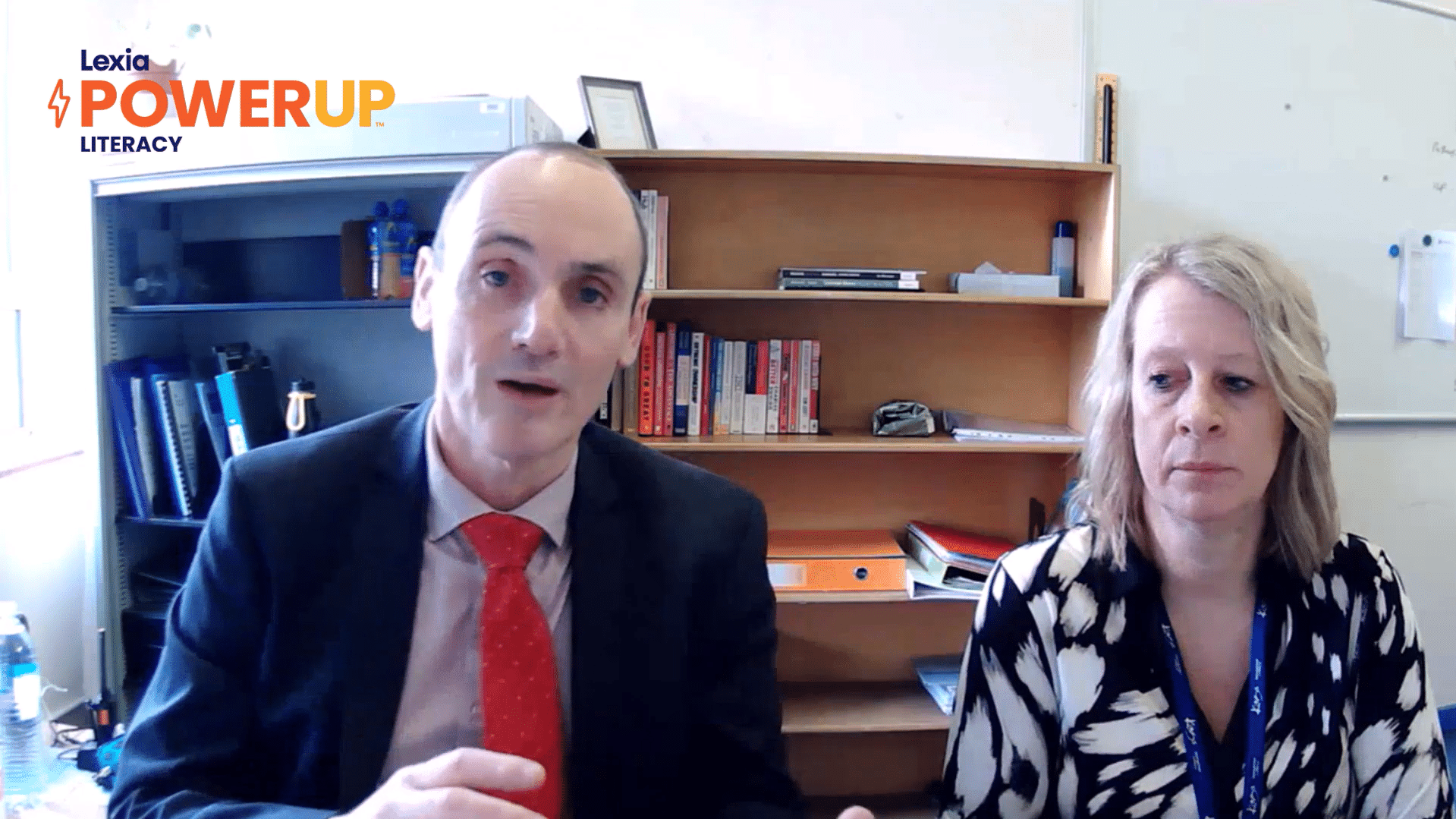
We spoke to Martin Byrne and Jo Stevenson at Kings International College. A non-selective secondary school, Kings International College have been a Lexia customer for over 6 years. Martin and Jo share with us how they implement PowerUp Literacy across a broad student cohort, share myLexia reports with concerned parents and keep students motivated on the programme.
How did you first come to across the Lexia programme and what led to the school’s final decision to purchase?
Martin: I know in the early stages; we weren’t using Lexia effectively. I think during that time it was used for very small, group SEN interventions only. Part of the challenge for us is that we didn’t have a very robust set to cohort level reading age data. As our use of Lexia started to develop we became better at benchmarking and assessing the whole school literacy in our incoming cohorts. Once we understood it more, we began to recognise the great value it provided in our interventions. We started on a small scale, felt the impact, and felt like it was worth investing in.
Which cohorts do you use Lexia with how and do you identify pupils to put on the programme?
Jo: We use the NGRT to initially assess the student’s reading age in Year 7, and regularly as they progress through Key Stage 3. We use that to determine what type of intervention they need. Obviously, we’re looking directly at students that need support with the relevant lexia strands of Word Study, Grammar and Comprehension. Once we’ve determined those students, I then run 3x 50-minute sessions with those students in a classroom. This usually goes on for a ter.
Martin: The actual selection of student we vary on the intake. We look at a combination of the NGRT data, standardised reading score and a difference between chronological reading age and reading age. This identifies a gap. Depending on how many student we’ve got in different cohorts, typically we’ll classify students’ literacy abilities as “wave one” in a similar way we would with SEND.
Wave one are students that can access the curriculum and are at their reading age. Wave two are between 18 months and 2 years below their chronological age and here is where Lexia intervention begins. Finally, wave three is where there is a much bigger gap, and we use Lexia here amongst other literacy interventions. Lexia we find gets students on track quickly. We use Lexia to arrest the narrow gaps.
What makes Lexia stand out from other interventions you’ve used in the past?
Martin: It’s impactful, it’s evidence-based and it has built in diagnostic tools that help track student progress. The reports get quite granular in terms of student engagement, what progress they’re making, and what areas they need to target to make meaningful improvement. Lexia isn’t a broad-brush approach. Once you’ve got students on this intervention, it’s tailored to their individual need.
Jo: The ability to pick out individual needs and how they need to be addressed. The myLexia reports are absolutely invaluable. Every Friday I run reports on each individual student, and this allows us to monitor students on an ongoing basis and have these conversations of “you need help in this area i.e. comprehension”
Describe the impact that Lexia has had on your pupils
Martin: I’ve found that we see less anxiety about attending lessons, more willingness to engage and really give it a go in mainstream lessons once the students return from the intervention. There is less regression and backsliding too, year on year the data comes through and we find that once a student has been through Lexia they hold ground better than they did with other previous interventions.
Jo: It’s the increase in confidence too. For example, I was in a lesson the other day that involved reading aloud, and one of the last year’s Lexia cohort had the confidence to stand up and read aloud. Sometimes this gets lost in you’re only looking at the data, but to see it in practice that they have increased confidence in the classroom is really good to see.
Can you give an example of a Lexia success that sticks out to you?
Jo: I think with this it’s important to start with the context of when they start on Lexia. Often the students are quite concerned – “Oh does this mean I have low reading ability” – so that knocks their confidence a little. The Year 11’s I’m working with now started Lexia when they were in Year 8, and some of them begrudgingly admit that “Yes Lexia did have an impact, and it was worthwhile”!
Martin: When the student has been through the Lexia programme, and the programme has been delivered with integrity, then it has lasting impact. There are a lot of variables that affect educational outcomes, and a lot of barriers. In our school, Lexia removes on of our barriers. What stands out about the students on Lexia is that there isn’t really a standout. The become the standard.
How have you used rewards to motivate and celebrate success on the Lexia programme?
Jo: As part of our school award system, we have achievement points, and when students on Lexia hit their targets then they receive an achievement point. What we’re careful to do is avoid only rewarding those students that have completed the most work, because quite often we find that lower ability students may have only completed a few units a week. We look more for if time has been well spent on Lexia and reward that instead, so we like to reward effort as well as achievement.
Motivation changes from year group to year group too. The Year 7’s really like the more gamified aspects and the streaks and comparing who has done the most work. They’re very eager to know if they’ve made the most progress! We have a boy at the moment that has a streak of 1200!
We have other rewards too; it’s a silly thing but having my chair, the teachers chair, is rewarded to the student that I feel has made the most effort that session!
How useful have you found the myLexia reports in terms of demonstrating progression and informing planning?
Jo: In terms of informing planning, the autoplacement at the beginning of the Lexia process is invaluable. All of the planning at early stages is built around that feature. It allows us to easily see what we’re dealing with.
The reports are great for feedback for parents too. We find that parents tend to get quite interested when they’re told their child is being given literacy intervention, and voice concern of “Oh gosh, I wasn’t aware there was an issue!”. We can then use the data in the reports to reassure them that we’re doing 100% of what we can for their child and show them their progress as the student moves through Lexia. It helps us to establish a relationship with the parent that feels more like a team.
What main piece of advice would you give to a school that was just getting started with Lexia?
Martin: What we’ve learned over the past six years, and the past three years of implementing the programme impactfully, is that it’s vital to get your student selection correct. Your Lexia cohort needs to be based on rigorous data. This is key.
We look not only at reading gaps, but attendance too. In secondary schools you need to be asking the question “Are they actually going to turn up and be present, or will we just be wasting our resources?”. Sometimes that is a hard call to make, but we have learned through experience over the years that it is necessary.
Lexia implementation staff do advise what works, and how to implement the course effectively. With any intervention there is a cost implication, be staffing or time. Trying to deliver Lexia without dedicated, well-trained staff will not deliver the full impact that the programme can have – that is recognised by the EEF.
I think that for any school leadership out there thinking about trying Lexia, I would recommend that you take the hit, invest financially in staffing and protect the time in the school day for it. If you ensure this from the beginning, then in pays dividends.